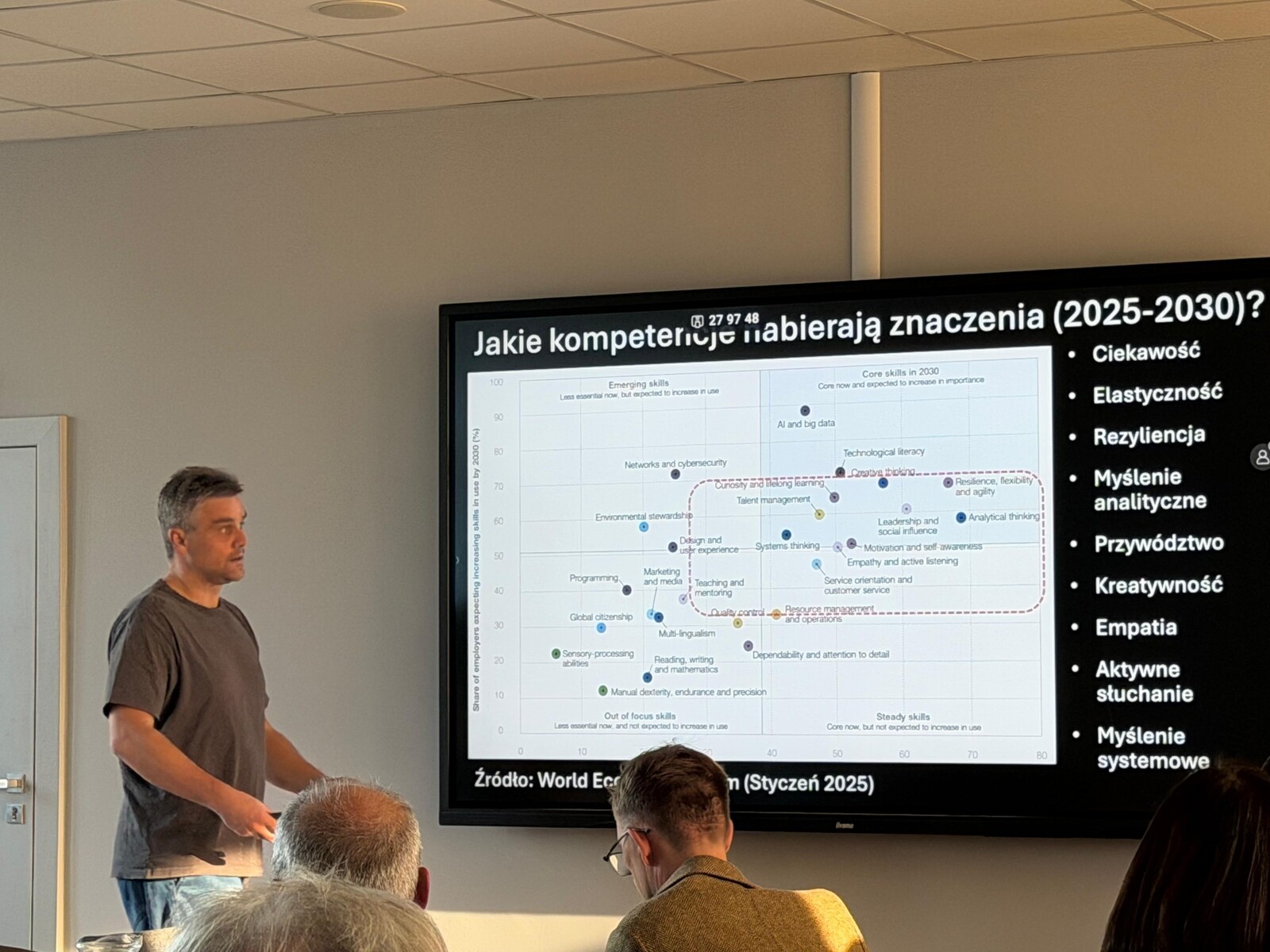


Researchers from Rzeszow University of Technology and the Human for Future Foundation explored this question during a seminar held on 5 November 2026.
The prevailing narrative surrounding AI implementation in businesses is often misleading, fuelling fears of job losses and the replacement of human workers by AI-driven automation and robots. At the same time, many companies struggle with unsuccessful and costly AI implementations that fail to deliver the expected results due to resistance to change within organisations.
Rzeszow University of Technology is carrying out a project that is unique on a national scale, funded under the "Science for the Development of Society" Programme of the Ministry of Science and Higher Education.
The project, entitled "Organisational Transformation Methodology for the Effective Implementation of Advanced Artificial Intelligence Technologies", brings together several particularly important components:
- It addresses four key challenges associated with implementing advanced technologies and AI in businesses:
- Low organisational readiness and resistance to change.
- Insufficient understanding of behaviours that support or hinder AI-driven transformation.
- Limited knowledge of the impact of AI on tasks, professional roles and human work, including the importance of tacit knowledge and the risk of skills erosion.
- The lack of a unified readiness assessment framework that takes into account structural, cultural and competency-related factors in the Polish context.
- It is an interdisciplinary project at several levels:
- It involves collaboration between three faculties of Rzeszow University of Technology: The Faculty of Electrical and Computer Engineering, The Faculty of Management, and The Faculty of Mechanical Engineering and Aeronautics.
- It is implemented jointly with a social partner, The Human for Future Foundation, whose primary objectives include the humanisation of technology.
- It is carried out in cooperation with businesses from both the Podkarpackie region and across Poland.
During the seminar, organised with representatives of the Business Council of the Faculty of Electrical and Computer Engineering, the project's objectives and the main challenges faced by companies implementing AI were presented. Business representatives participated in a workshop exploring which tasks and areas of business operations could benefit from AI-driven automation, which cannot be automated, and the reasons behind these limitations.
The approach to planning automation based on tasks performed within a particular job role can be structured around the assessment of four key indicators:
T – Technical Feasibility of Automation – the technical possibility of automating a task.
P – Practical Feasibility of Implementation – the practical possibility of implementing automation.
A – Augmentation – the potential of AI to support and enhance human work.
H – Human Factor – the extent to which a task depends on human involvement.
The TPAH methodology was developed as an outcome of a project carried out for the Regional Labour Office in Rzeszów, which tested an innovative model for assessing the potential transformation of work resulting from the adoption of AI. As part of the project "Organisational Transformation Methodology for the Effective Implementation of Advanced Artificial Intelligence Technologies", the TPAH methodology will be further updated and developed to support the effective implementation of AI in organisations.
The areas and scope of selected research topics addressed by the project were also outlined in the monograph entitled "Analysis of Information Technology Education in Vocational Schools in the Podkarpackie Region in the Context of Preparing a Workforce for the Digitalisation and Automation of Production Processes" (more information is available at: https://w.prz.edu.pl/uczelnia/aktualnosci/pracownik-przyszlosci-edukacja-i-technologie-na-rzecz-rozwoju-gospodarczego-i-bezpieczenstwa-podkarpacia-3047.html).
The monograph was prepared by researchers from the Department of Complex Systems at the Faculty of Electrical and Computer Engineering, Rzeszow University of Technology.